Question:
Why Hydraulic Oil Filtration Is Beneficial? Why Should We Invest In Cleaning Oil?
Foreign particles when enter into systems hydraulic fluid cause damage to our hydraulic systems.
Contamination issues disease hydraulic systems and hence decrease efficiency, increase expensive repairs and failure of systems.
Three fourth of hydraulic system failures are traced back to contamination levels in hydraulic fluid.
So, it makes common sense to prevent contaminants to enter into a system and to proactively remove them using measures and systems such as filtration carts, dedicated bypass systems, breathers, inline filters, etc.
TYPES OF CONTAMINANTS
ABRASIVE OR PARTICULATE CONTAMINANT
These include sand, dirt of metal flakes-leading to cavitation, formation of vapors filled cavities and are serious concerns for pump, valve, motor failures. These have a sandblasting effect in the piping and flow systems, further generating more contaminants.
NON-ABRASIVE CONTAMINANT
Elastomeric seals and chemical by-products are equally damaging –clogged parts, stuck valves are failures generated by them. Likelihood of cavitation increase with presence of non-abrasive contaminants.
MOISTURE CONTAMINANT
The increase in oxidation is tenfold with presence of moisture.
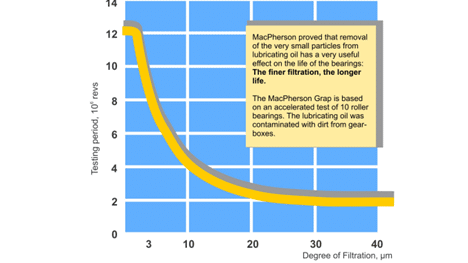
This graph indicates that by increasing filtration ratio from 30 micron to 3 micron component life increase 3-4 times
IDENTIFYING SOURCES OF FLUID CONTAMINATION
The importance to understand the various sources of fluid contamination can help us preventing it.
At the end of the day, contamination can occur almost anywhere. But if you know when and where it’s happening right steps to correct and minimize any contamination can be taken.
- Hydraulic Fluid Manufacturing
- Hydraulic Fluid Production & Storage
- Handling & Transfer
- Operation & Maintenance Of Equipment
BASICS-PREVENTING OIL CONTAMINATION
- Regularly Test & Analyze Hydraulic Fluid
- Remove Particulate Contamination
- Keep Everything Clean
- Properly Store & Handl